
LLC vs. Corporation (and S-Corp): A Founder-Friendly Breakdown
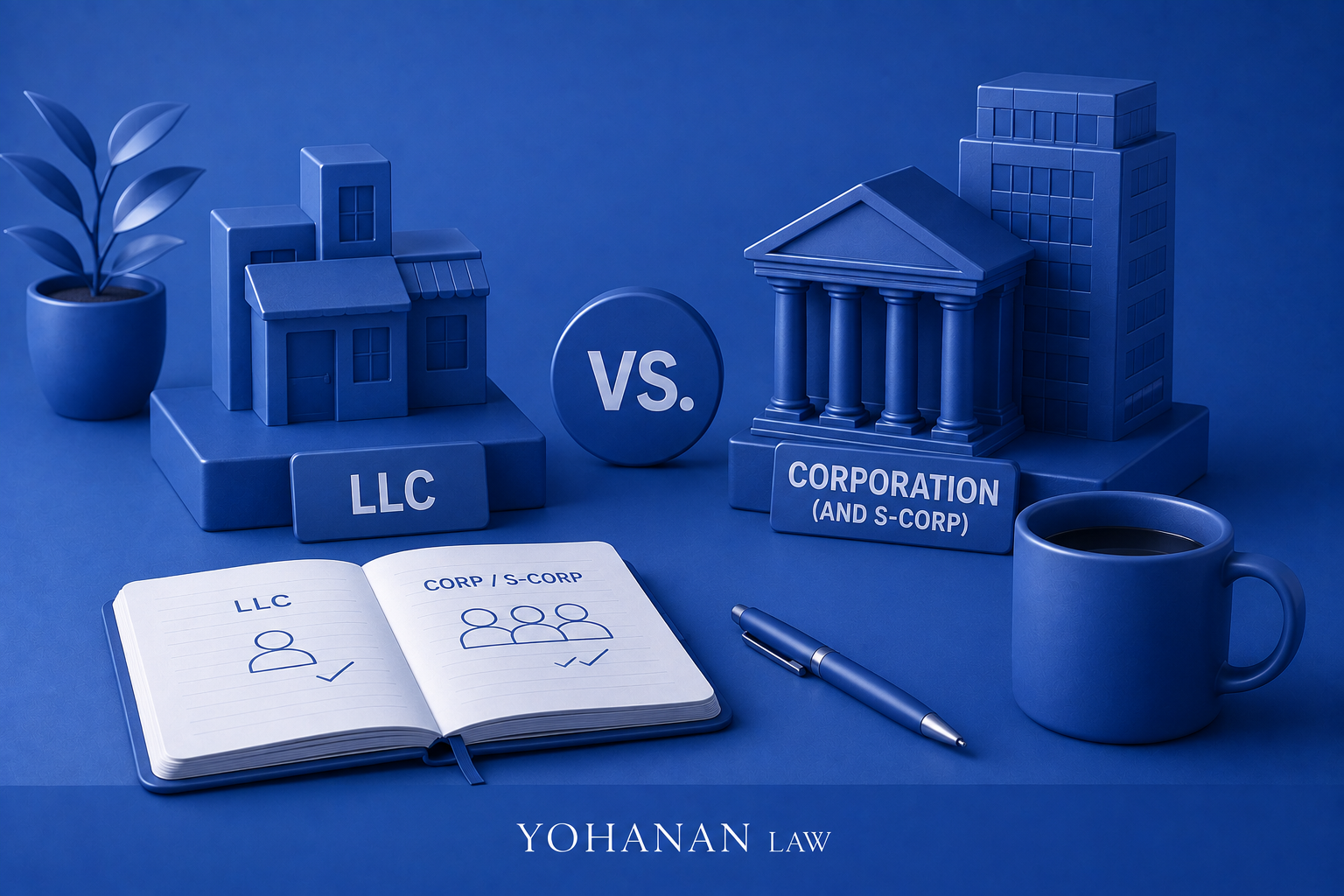
Picture this: it’s a quiet afternoon, and you finally sit down to make your business “real.” You’re ready to form an entity… until the options pop up.
LLC? Corporation? What exactly is an S-Corp?
What seems like routine paperwork is actually one of the first strategy calls you’ll make as a founder. The structure you choose shapes how you’re taxed, how investors view you, and how easy it is to grow or exit later.
LLC: The Flexible, Low-Friction Option
Think of an LLC as the “everyday carry” tool of business structures.
It’s designed for simplicity and control. Taxes flow through to you directly, so you don’t deal with a corporate tax layer. There’s no mandatory board, no officer titles that you must maintain, and no rigid meeting requirements.
The biggest advantage? LLCs let you customize the sharing of ownership and profits. If two founders each own 50% but one is working fulltime while the other stays parttime, you can decide together that profits won’t be split evenly to start. Corporations don’t give you that kind of flexibility.
On the flip side, institutional investors tend to avoid LLCs, not because they’re “bad,” but because they are unfamiliar and harder to slot into the standard fundraising playbook.
Equity incentive plans also get more complicated with LLCs because there is no set standard. You are in charge of determining how the financial interests and voting interests in the LLC are divided, so if you want different member interest allocations or profit-sharing splits, you need to specify that your operating agreement.
Additionally, depending on how your income flows, some founders face higher self-employment taxes as you are taxed on all profits even if you reinvest the money in the business.
For many small businesses, creatives, consultants, and cashflow-focused companies, an LLC feels natural. For venture-bound startups, it often feels like wearing hiking boots on a basketball court: great tool, wrong game.
Corporation: Built for Scale and Investment
Corporations, especially Delaware C-Corps, are the default for high-growth startups. They come with more structure: a board, bylaws, formal roles, and annual meeting requirements. But this structure is exactly what makes them investor friendly.
A corporation’s “clean cap table” simply means everyone’s ownership is represented as standardized shares. Investors like to see predictable ownership, standardized stock, and familiar rules around how equity behaves. Corporations also make it much easier to issue stock options and other equity incentives.
Corporations do bring administrative weight. You deal with more filings, more governance, and potentially double taxation if you're distributing profits instead of reinvesting them. But they also unlock things like standardized fundraising instruments and, for some shareholders in qualifying companies, potential long-term tax advantages such as QSBS treatment.
If your goal is scale, fundraising, and a streamlined equity story, a corporation is usually the smoother road.
Where the S-Corp Fits In
Here’s the part many founders misunderstand: an S-Corp is not a separate type of legal entity. It’s simply a tax election made by an LLC or a corporation.
The appeal is straightforward: S-Corps avoid double taxation and allow owners (when done correctly) to reduce self-employment taxes by taking part of their earnings as salary and the rest as distributions. They also maintain liability protection.
But S-Corps come with strict rules. You can only have one class of stock, which immediately makes them incompatible with traditional venture structures. There are caps on who can own shares and limits on how many owners you can have. In other words, great for small, growing businesses; not great for VC-backed ones.
Can You Change Later?
Fortunately, yes. Moving from an LLC to a corporation is one of the most common transitions founders make, and in many states, it can be done with a straightforward statutory conversion. Going in the other direction from corporation to LLC is technically possible but usually triggers taxes that make the move painful once your company has value.
A Few Real-World Scenarios
If you’re building a consulting practice or service business with meaningful cashflow, an LLC (sometimes with an S-Corp tax election), often gives you the best mix of simplicity and tax efficiency.
If you’re building a venture-scale SaaS product and even think you’ll raise from outside investors, starting as a corporation saves you from cleanup work later and helps you issue equity without headaches.
If you don’t know yet, think about where you want to be one to two years from now. If there’s any chance you’ll raise, a corporation tends to be the “safer” long-term bet.
Bottom Line
Choosing an entity isn’t about guessing what investors want, it's about choosing the foundation that matches the kind of business you’re building.
LLCs maximize flexibility, simplicity, and passthrough taxation.
Corporations provide the clarity, structure, and equity tools needed for scale.
S-Corp taxation offers unique advantages, but only within certain boundaries.
Pick the structure that supports the trajectory you’re aiming for, not just the one that feels easy in the moment. Getting this right early saves you from expensive cleanup when the stakes are higher.