
Founder IP Assignment vs. CIIAA: Why Startups Need Both

When launching a startup, securing intellectual property (IP) is just as critical as building your product. If you ever want to sell your company or want to attract investors, you’re going to need to ensure that you can show that the company owns all of its IP.
Two agreements often come into play: the Founder IP Assignment Agreement and the Confidential Information and Inventions Assignment Agreement (CIIAA). While they sound similar, they serve different purposes, and both are essential for a clean IP chain of title.
As a quick side note before we dig into this topic, you may also see a document called a Proprietary Information and Inventions Agreement (PIIA) rather than a CIIAA. In essence, these documents accomplish the same goal, they are just organized differently. For purposes of this blog, we only refer to CIIAA.
What Is a Founder IP Assignment Agreement?
A Founder IP Assignment Agreement transfers ownership of any IP created by the founders before or during the formation of the company to the company itself, typically in exchange for the initial company stock.
Founders often develop technology, branding, or processes before incorporation, such as domain names, logos, or code. Without this agreement, those assets may remain personally owned by the founder(s), which could create hefty legal and financial risks as the company grows.
Why it matters:
Ensures the company owns its foundational IP.
Avoids disputes if a founder leaves.
Makes future fundraising and acquisitions smoother.
Timing: Typically signed at or immediately after incorporation.
What Is a Confidential Information and Inventions Assignment Agreement (CIIAA)?
The CIIAA governs IP created after someone joins the company and protects confidential information. It’s signed by employees, contractors, advisors, and even founders for their ongoing work.
Key features:
Invention Assignment: Transfers ownership of inventions developed during employment or engagement with the company.
Confidentiality: Requires individuals to keep sensitive company information private.
Disclosure of Prior Inventions: Carves out pre-existing inventions that will not be assigned to the company.
Timing: Signed during the service provider’s onboarding or engagement.
Key Differences at a Glance
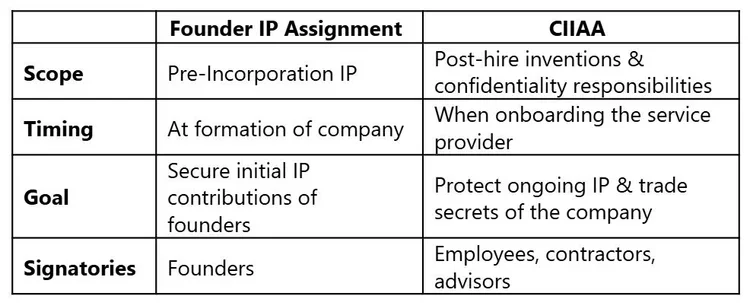
Why Both Are Essential
Founder IP Assignment ensures the company owns its foundational IP.
CIIAA ensures the company owns what’s built going forward and keeps its secrets safe.
Together, these agreements create a clean IP chain of title, which is critical for investor confidence, acquisitions, and the long-term success of the company.
Pro Tip: If you’re forming a startup, make these agreements a priority. They are the backbone of your company’s value, so take care of the agreements as soon as possible. And remember to get a CIIAA for each and every service provider you work with during the company’s lifetime