
LLCs and Corporations Don’t Always Protect You
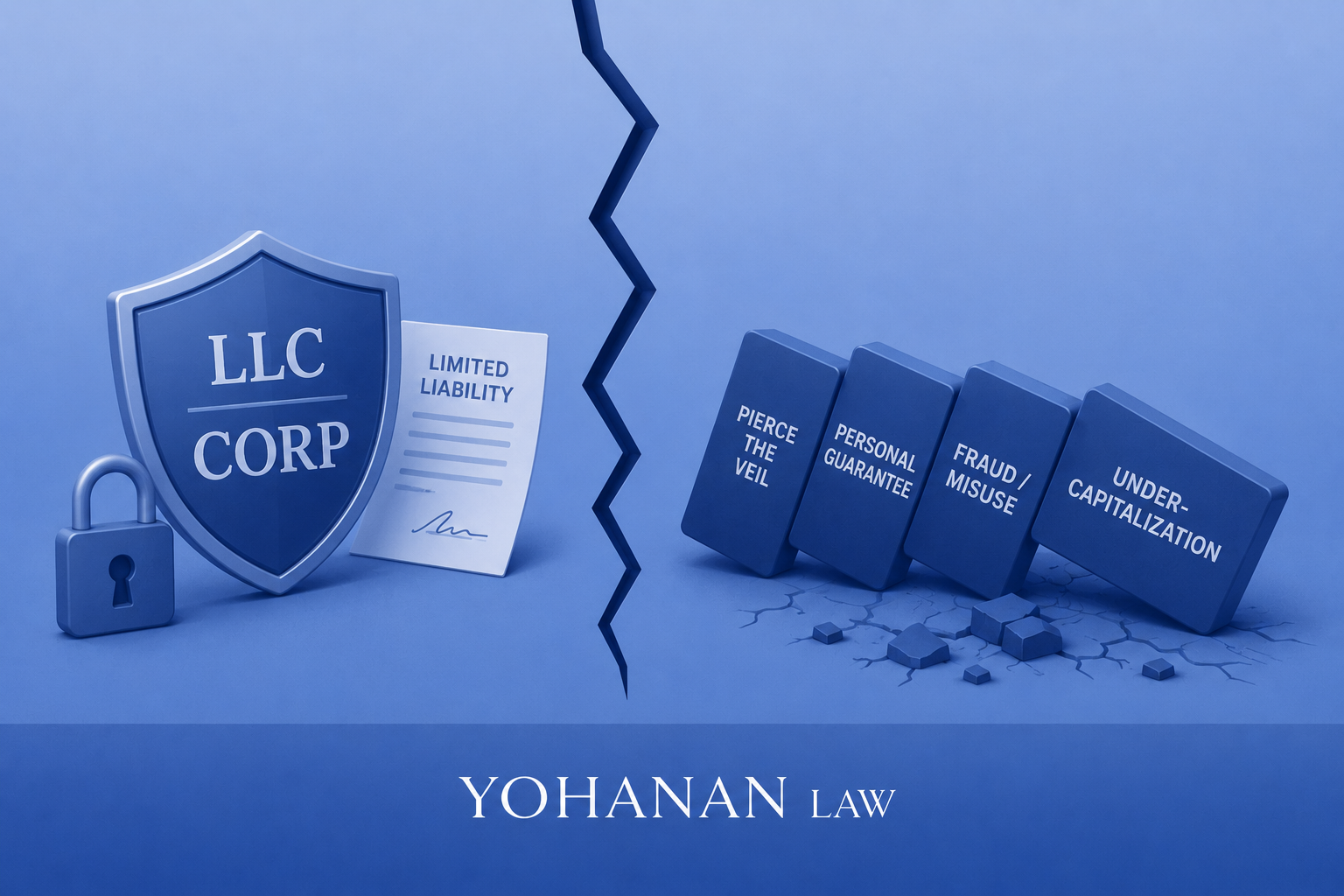
LLCs and corporations do not provide absolute liability protection for owners. Investors and entrepreneurs have long perceived LLCs and corporations as powerful shields, but that perception is changing.
Today’s courts are increasingly willing to “pierce the corporate veil” and allow owners of legal entities to be held personally responsible for the liabilities of the legal entity. Some surveys say that half of all veil-piercing claims in the US are successful, and courts are three times more likely to pierce the veil in a contract case than a torts case.
This should be alarming to business owners who rely on their LLC or corporation to act as a shield from personal liability.
Legal Test to Pierce the Veil
Buyers in an APA are not liable for the seller’s debts unless they expressly assume them. However, U.S. courts have carved out exceptions that vary by state. In most states, the buyers in an APA are subject to successor liability under the “mere continuation” exception.
The traditional legal test of whether a legal entity’s liability shield can be penetrated requires two facts to be true:
(1) the owner of the entity has complete control over the entity, and
(2) the owner of the entity used the entity to advance fraud or wrongdoing.
Recent Cases
Historically, courts rarely pierced the veil without a show of fraud.
Now the courts of New York, and many other states, are increasingly willing to pierce the veil (even without a showing of fraud). In contrast, Delaware courts still tend to maintain a stronger shield.
Delaware
In Manichaean Capital, LLC v. Exela Technologies (1999), the seminal Delaware case on veil piercing, the Chancery Court held that “The underlying injustice must be more than the breach of contract itself; it must reflect an inequitable use of the corporate form tantamount to fraud.”
In a recent case, Wallace ex rel. Cencom Cable Income Partners II (2021), the Delaware Court of Chancery affirmed that the company “must be a sham and exist for no other purpose than as a vehicle for fraud.”
New York
Instead of requiring fraud, New York courts require only that the actions of the owner or parent company “result in a wrong or inequity,” according to Rich v. J.A. Madison (2025), from the Manhattan appellate court.
A similar decision, HLI Rail & Rigging v. Franklin Exhibit Mgmt. Group (2025), from the state appellate court in Brooklyn, ruled that “the corporate veil will be pierced to achieve equity, even absent fraud.”
Practical Guidance
In practice, this means courts will not allow owners to protect themselves by using the following structures, which are not necessarily fraudulent:
For corporate structures with parent companies and subsidiaries, parent companies should not sweep all cash from subsidiaries as part of a centralized cash management structure. This could be viewed by courts as a scheme to ensure that corporate subsidiaries have no liquidity to pay debtors.
For all entities, don’t enter into contracts that the company cannot perform at the time of contracting. If courts think that the company was never viable and still entered into a contract knowing that the entity would have no money to pay, then the courts will view that as a scheme by the owner worthy of piercing the veil, even if the court doesn’t call it a fraud.
Include provisions in contracts where the parties agree not to even try to pierce the corporate veil i.e. the No Recourse Against Others Clause.